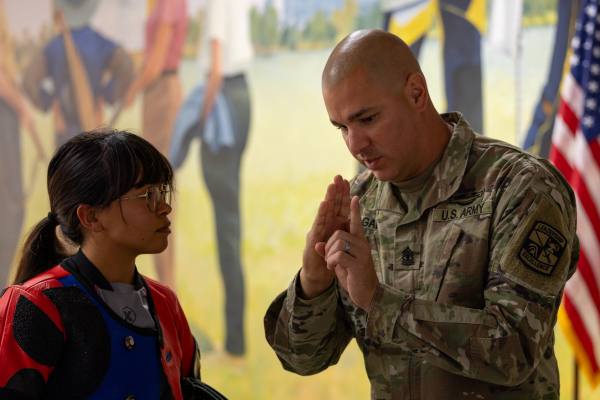
Turn your career into a calling: Leading the next generation
By Reina Vasquez, Editor, Army Retirement Services April 2026
Created as part of the National Defense Act of 1916, the Army Junior Reserve Officers’ Training Corps (Army JROTC) is one of the largest youth development and citizenship programs in the country today.
Col. Lee A. Evans, director of Army JROTC, says, “Our purpose is to instill in students the values of citizenship, service, personal responsibility, and a sense of accomplishment.” All activities, he continued, revolve around our mission statement. “The mission,” he says, “is to motivate young people to become better citizens.” A perennial pursuit, if you will.
About twenty percent of Army enlistments come from schools that have an Army JROTC program, says Evans. “Those young men and women tend to have a propensity to naturally gravitate toward service in the military.” The program itself; however, takes a broader view of what it means to serve. “Instilling the value of service can be done at any level and in any form, and that’s what we teach our students,” says Evans.
It’s these core skills like critical thinking, teamwork, and problem solving, that translate into any workforce – be it military, national, or public service.
Following the 2023 National Defense Authorization Act (NDAA), JROTC instructor positions were no longer limited to retired personnel. New opportunities also opened for officers and NCOs who recently separated from service and served honorably. To learn more about all the eligibility guidelines, visit usarmyjrotc.army.mil, where you’ll also find close to 500 current vacancies for Army Instructors (AI) and Senior Army Instructors (SAI). Service members serving in the U.S. Army Reserve (USAR) or the Army National Guard (ARNG) are also eligible given they meet the time in service, grade, and education requirements. With just over 1,750
active programs throughout the country, in U.S. territories, and Department of Defense Education Activity (DODEA) schools overseas – in both public and private schools, it’s no surprise that JROTC is in high demand.
“Today, we have approximately 300,000 students participating in Army Junior ROTC, and more than 4,000 instructors teaching and guiding the next generation.”
Evans noted significant changes for the program in the coming years, including a three-program expansion, with authorized instruction in science, technology, engineering, and mathematics (STEM). "This allows the Army to enhance opportunities for students to participate in drone technology, robotics, and 3D printing.”
With new courses offered in health and fitness, as well as robotics, the changes are exciting. Army JROTC has multiple initiatives that align with current changes in secondary education. In addition to curriculum modernization, many Army JROTC programs participate in career and technical education, where students can earn a credential in Leadership and Employability Skills.
“As we look to grow Army JROTC by at least 35 programs per year, our expanded curriculum will give school administrators the flexibility to adopt course offerings that best suit their students and desired outcomes for their schools, while maintaining the core lessons that motivate young people to be better citizens,” Evans said.
Another aspect of the JROTC program expansion is its geographic presence and where the program is underrepresented. “We have a very strong presence in the Southeast and along the East Coast,” Evans noted, “but there are areas where we’re trying to increase our footprint like the Northeast, the Midwest, and along the West Coast.”
What continues to draw many students and instructors alike to the wildly successful 110-year-old citizenship and leadership program is the structured environment that offers confidence, team-building, personal growth, mentorship, and a sense of belonging. All these things, again, transcending the boundaries of occupational limits, while fostering connection and personal excellence.
If you’ve read the article to this point, you may be asking yourself, “What does this have to do with my Army retirement?” Great question! Here’s my answer: In an era of accelerating change, opportunities abound for Soldiers who have hung up their uniform. You can take part in cultivating the adaptable, and curious leaders of our future. In other words, this may be just what you’re looking for!
You’re staying connected to the Army, developing, mentoring, sharing your knowledge and experience in a highly effective and impactful program.
What could be more worthwhile? Seize the opportunity to model exactly what you’re teaching! Continue to impart lessons from your past service to enrich the lives of today’s youth – for tomorrow’s future.
Once you’ve decided what vacancies you’re interested in based on location and school district, anticipate a 6-8 month hiring process, including submitting a formal application, undergoing background checks, physicals, online training, and certification reviews.
Most instructors work on a 10 or 11-month contract and hiring is done by the individual school districts, said Evans. “I think we can all look back on our formative years and name teachers who made a difference in our lives,” he continued.
“We want our cadets to value service beyond themselves,” said Evans. “What this program does — what our instructors do — can change the trajectory of a youngster’s life.”
And while JROTC provides plenty of opportunities to hone hands-on skills like marksmanship,
drone piloting, or robotics, it’s the less tangible skills that are the most meaningful to the instructors, Evans stated. “Skills such as resilience, empathy, integrity, and emotional intelligence, are equally if not more important.”
For further insights on the Army’s JROTC programs and instructor positions, visit their website at: usarmyjrotc.army.mil.