Forging the future: A journey through USAREC's Force Generation Pipeline
By Sgt. Maj. Chris Klutts, USAREC Public Afffairs May 2026
We share this update on USAREC’s mission to let you know that the process for today’s recruit may be more digitized, but the path to their first unit is much the same as the one you navigated. Keep encouraging the next generation to consider service whenever you share your Army story.
In October 2025, U.S. Army Recruiting Command (USAREC) began transforming to create efficiency for the U.S. Army while continuing to attract and recruit qualified applicants. USAREC’s new mandate is to manage the service’s entire Force Generation Pipeline – from first contact with a potential applicant to first unit of assignment following initial training.
USAREC currently commands U.S. Army Recruiting Division (USARD), U.S. Army Cadet Command (USACC), the Army Enterprise Marketing Office (AEMO), the Army Training Center & Fort Jackson, and staff from the Center for Initial Military Training.
As USAREC moves toward initial operational capacity regarding its training mission in October 2026, the headquarters will continue to solidify its command relationships with units that provide initial entry training for enlisted Soldiers, commissioned officers and warrant officers. That includes Basic Combat Training (BCT), Advanced Individual Training (AIT), Basic Officer Leader Course, and One Station Unit Training (OSUT).
What does that mean for Chris, a high school senior who is exploring what to do with his life after graduation?
As Chris scrolls through his social media feed after school and hockey practice, he sees an ad featuring quick clips of Soldiers in the field. One is a view from behind a machine gun while riding through the desert. Then a team patrolling in a jungle, waist high in brown water with an unmanned ariel system overhead. A view of a forest from the cockpit of a tank. A doctor making quick decisions to save a life.
The ad is part of the Field-Tested campaign, USAREC’s latest television and social media campaign developed by AEMO, in Chicago. Chris has seen a few ads before. Now he’s interested. He clicks on the “Learn More” prompt in the video which brings him to a mobile-first designed website, GoArmy.com.
Flipping through the site, he sees options ranging from working on helicopters, to creating a bridge for Army vehicles, to becoming a leader and paying for college through ROTC, USAREC’s primary commissioning source managed by USACC. One more flip and he sees another image of a Soldier in the jungle. Military occupational specialty 11B. Infantryman. Chris sees a banner at the bottom of his phone that reads “Start Your Career” with icons prompting him to message, email or call. He starts a chat with a member of AEMO’s Go Army contact center. After completing a brief questionnaire, he receives his local recruiter’s contact information. Before he can call, a recruiter from USAREC’s USARD calls Chris and asks him when and where they can meet. Chris says he’d like to meet after hockey practice at the rink. The recruiter agrees and brings the recruiting station to Chris the next day.
First the recruiter talks with Chris to learn about his life – finances, family, school. Then he asks Chris why he wants to join the Army as an infantryman. Chris says he’s joining for the bonus money, to pay for college, and to experience the adventure of being a Soldier.
Chris studies for and passes the Armed Services Vocational Aptitude Battery (ASVAB), then completes a physical at the Military Entrance Processing Station, or MEPS. He signs a contract to become an infantryman and learns he will ship out to Fort Benning, Ga., for OSUT, to begin his journey after graduating from high school. Chris’s recruiter stays in contact with him for the rest of his senior year as part of USAREC’s Delayed Entry Program (DEP). They meet up a few times for physical training. Chris feels mentally and physically ready to go.
A month after high school graduation, the recruiter drives Chris and a few other applicants to a hotel near the MEPS where he completed his physical. The next day he flies to Atlanta.
Led by a Soldier at the airport, Chris and his new battle buddies board a bus at night. It’s late. Chris sees the signs for Fort Benning as they pass through a security gate. The bus slows to a stop at USAREC’s 30th Adjutant General Reception Battalion. A man in uniform and a brown campaign hat with gold crossed rifles bordered by a blue disk enters the bus. The drill sergeant directs everyone to collect their belongings and enter the building to begin in-processing.
Over the next few days, Chris wakes up early, receives his uniform and equipment, gets a haircut, goes through another medical screening, and finishes financial and other administrative tasks. Chris knows he will soon start the training he’s been waiting for.
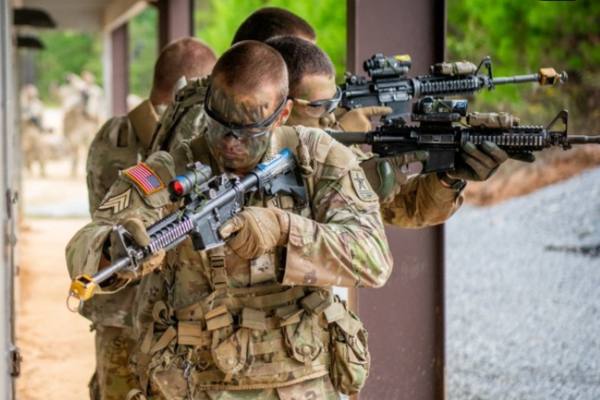
The next morning, Chris takes another bus, this time to his new home – B Company, 2nd Battalion, 54th Infantry Regiment. USAREC’s infantry drill sergeants immediately start barking orders when the bus arrives. He quickly learns he already has a mission – the First Hundred Yards. Led by his drill sergeants, Chris and his fellow trainees move supplies down a long hill to a track. As they deliver the supplies at a track, he sees another platoon starting physical training together. It sets in – Chris realizes this is his new life for the next few months. He’ll become a U.S. Army Soldier after 10 weeks, and a qualified infantryman eight weeks later.
After this latest graduation, Chris says goodbye to his family again. He thinks back to the first social media ad. Chris has completed USAREC’s Force Generation Pipeline.
He’s an infantryman – lethal and ready as he ships to his first unit of assignment.